Most AI work is a feature waiting to be absorbed.
3p0 is a small practice. We look for problems that are already costing you something, and build the thing that stops the cost.
The Position
The Position
The models are substrate now.
Every few months they get cheaper, faster and more alike, and every few months more of what was sold as AI expertise becomes a default setting in somebody’s platform. Substrate is necessary. Nothing durable lives there.
An automation is a feature.
A feature is a line item, and platforms absorb line items, usually within the year, usually for free. A wrapper on a model’s current ability is not an advantage. It is a countdown.
What lasts is a composition:
several capabilities arranged around a real process, producing an outcome that was not available before at that cost, speed or scale. Platforms do not absorb compositions. A platform cannot see the process they are arranged around.
Finding compositions is not an AI skill.
It is knowledge of the problem: how the system works, how the process actually runs, what the people inside it do all day, what genuinely breaks. You cannot compose capabilities you do not understand. But the sequence matters: outcome first, mechanism second.
The Container
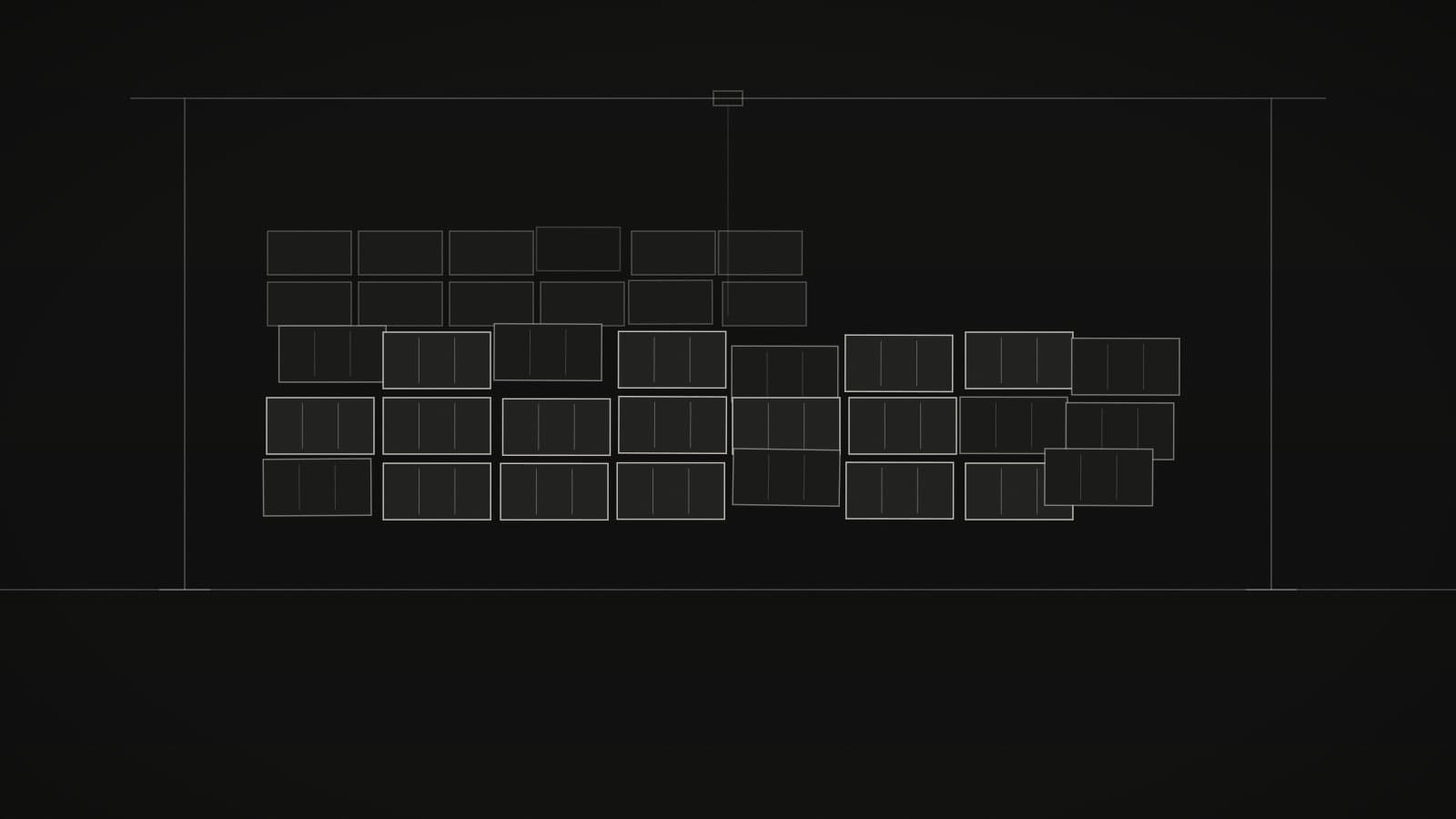
The Container
The shipping container was never a better box.
The innovation was the re-composition: ships, cranes, ports, trucks and labour agreements, rebuilt around one standardised unit.
It was executed by a trucking operator who understood freight, not by a shipbuilder.
The box was trivial. The system redesign carried most of world trade.
Method
How we decide what to build
We ask what it costs before we say anything.
A real problem has a price that exists whether or not we show up. It is being paid in lost deals, in errors someone absorbed quietly, in performance that never arrived and was never accounted for. So we ask first, and we stay quiet. If the person who owns the process can state the cost in their own words, unprompted, the problem is real. If the cost only becomes visible after we have explained it, we have not found a problem. We have found an audience.
We look for the workaround, not the complaint.
Complaints are cheap. People will produce them on request, and they will describe whatever they have most recently been annoyed by. Workarounds are expensive, and people build them anyway. The spreadsheet that runs alongside the system. The group chat where the coordination actually happens. The report someone rebuilds by hand every Monday because the official version is wrong. The one person who simply knows, and whose holidays are a risk to the business. A workaround is a costed vote. It proves the need was worth paying for in human labour before anyone offered software. Where we find no shadow process, we assume the pain is theoretical until shown otherwise.
We check whether the problem is actually ambiguous.
Most things called AI problems are process debt. Two systems that were never reconciled. A missing definition. An approval step nobody can justify. A decision rule that was always deterministic and got lost. If a database fix, a rules engine, or deleting a recurring meeting would solve it, that is the answer, and it costs an order of magnitude less than we do. This work is the right instrument only where the input is unstructured, the judgment is contextual, and variance is the substance of the task rather than a defect in it. We will tell a client that they do not need what they came to buy.
We ask what happens if the substrate gets twice as good.
Most advantages in this field are built on a model’s current weakness. Scaffolding that compensates for something the technology cannot yet do is a real advantage with an expiry date, because the thing you built around improves every few months, for free, for everyone, including whoever competes with you. So we ask it directly: if the underlying capability doubled tomorrow, would this be stronger or dead? What holds is rarely technical. It is a data-ownership line, a regulated process where the constraint is liability rather than capability, a trust relationship nobody extends to a vendor, an organisational seam a single platform cannot stand on both sides of, or a domain whose real rules are unwritten and held by the people who do the work. We build on hardness that is structural, not temporary.
We describe the failure before we build the capability.
Before anything is made, we say how it fails, who notices, how quickly, and what it costs to recover. If the failure is silent, or slow to surface, or lands on someone who did not choose to be involved, then the check gets built before the capability does, or the thing does not get built. Where a system’s output falls on a person, that person needs standing: consent, an explanation they can read, and a way to contest it. Not as a gesture. A system nobody can argue with is a system nobody should trust, and that includes us.
What we have not solved.
These are the criteria we apply, not a claim to have applied them perfectly. Two of them remain genuinely open. We do not yet have a reliable way to tell whether an organisation can change its own behaviour enough to use what we build; a working tool nobody adopts is a failure with better documentation, and we have found no test for this better than spending time in the room. And we do not know where the line sits between knowledge a practitioner contributes and knowledge a tool comes to own. We think the people whose judgment sits inside a system should have standing in it. We are still working out what that means in practice.
Contact
Contact
3p0 takes on few engagements, and will tell you when AI is the wrong instrument.